
LEARNING & DEVELOPMENT
About Agile Scrum
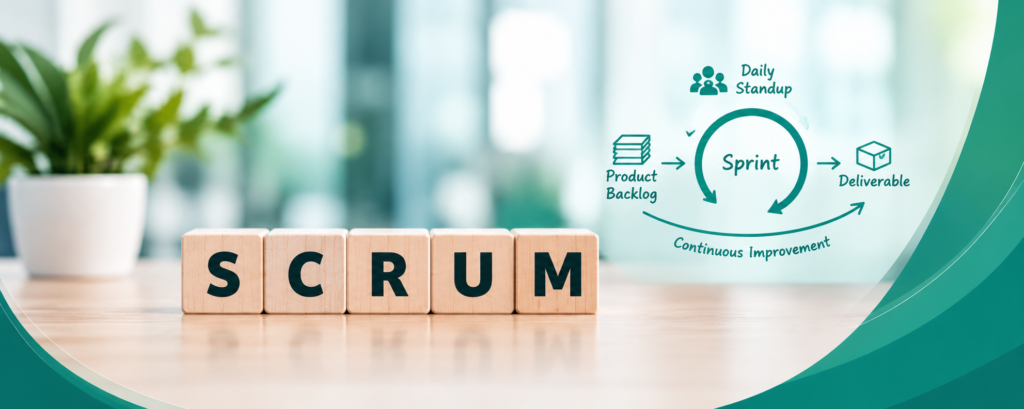
Scrum ensures transparency in communication and creates an environment of collective accountability and continuous progress. The Scrum framework is structured in such a way that it supports product and service development in all types of industries and in any type of project, irrespective of its complexity.
A key strength of Scrum lies in its use of cross-functional, self-organized, and empowered teams who divide and execute their work in short, concentrated work cycles called Sprints. The focus of Scrum on value-driven delivery helps Scrum Teams deliver results as early in the project as possible.

Scrum Fundamentals Certified (SFC™)
This course is tailored to help anyone interested to know more about Scrum; learn about key concepts in Scrum as defined in the SBOK™ Guide; and to get a basic understanding of how Scrum framework works in delivering successful projects. This course is included as a part of Free Primary Lifetime Membership.
Scrum Developer Certified (SDC™)
Scrum Developer Certified (SDC™) is an entry level certification for Scrum Team members and those who interact with any Scrum Team. The objective of this certification is to ensure that Scrum Team members know enough about Scrum to effectively contribute to a Scrum project. The courseware and preparation tools required for the certification exam will be available with the package.
Scrum Master Certified (SMC™)
Scrum Master Certified (SMC™) professionals are facilitators who ensure that the Scrum Team is provided with an environment conducive to completing the project successfully. The Scrum Master guides, facilitates, and teaches Scrum practices to everyone involved in the project; clears impediments for the team; and ensures that Scrum processes are being followed.
Scrum Product Owner Certified (SPOC™)
Scrum Product Owner Certified (SPOC™) is an advance level certification which requires prerequisite of SDC™ (or) SMC™ certified professional. The Product Owner represents the interests of the stakeholder community to the Scrum Team. She/He is responsible for ensuring clear communication of product or service functionality requirements to the Scrum Team, defining Acceptance Criteria, and ensuring those criteria are met. She/He must always maintain a dual view. She/He must understand and support the needs and interests of all stakeholders, while also understanding the needs and workings of the Scrum Team.
Successful trainees will be awarded the Scrum Fundamentals Certified, Scrum Developer Certified (SDC™), Scrum Master Certified (SMC™) and Scrum Product Owner Certified (SPOC™) certification after passing the exam.
ISO Standard Certifications
Quality Testing
Quality testing ensures that the software meets requirements, performs reliably, and is ready for real-world use. It involves a combination of agile practices, including automated and manual testing, to verify that the product works as intended, is bug-free, and delivers a seamless user experience.
In an agile environment, testing is an ongoing activity, integrated throughout the development cycle, with close collaboration between developers, testers, and product owners to maintain high quality and customer satisfaction.
Agile testing
A software testing practice that follows the principles of agile software development is called Agile Testing. Agile is an iterative development methodology, where requirements evolve through collaboration between the customer and self-organizing teams and agile aligns development with customer needs.
Functional Testing
Functional testing is a quality assurance (QA) process and a type of black-box testing that bases its test cases on the specifications of the software component under test. Functions are tested by feeding them input and examining the output, and internal program structure is rarely considered (unlike white-box testing). Functional testing usually describes what the system does.
Performance Testing
Performance testing is the process of determining the speed or effectiveness of a computer, network, software program or device. This process can involve quantitative tests done in a lab, such as measuring the response time or the number of MIPS (millions of instructions per second) at which a system functions. Qualitative attributes such as reliability, scalability and interoperability may also be evaluated. Performance testing is often done in conjunction with stress testing.
Regression Testing
Regression testing is a type of software testing which verifies that software which was previously developed and tested still performs the same way after it was changed or interfaced with other software. Changes may include software enhancements, patches, configuration changes, etc.
Digital Incident Report (DIR)
Tracks and manages software incidents and defects, ensuring timely resolution and continuous improvement in product quality.
DIR Users:
- Insurance Companies
- Adjusters
- Forensic Investigators